


From Eleanor’s Caldwell Private Journal
Richmond Confederate Hospital
March 7, 1862
Late Evening
This marks my fortieth day working in the fever ward proper. The number pleases me—a full accounting of weeks spent in what Dr. Merriweather terms “the most demanding arena of modern medical practice.”
Where other volunteers recoil from the severity of symptoms these patients exhibit, I find myself increasingly drawn to systematic observation of their condition.
Mrs. Patterson positively blanched this morning when Dr. Merriweather assigned me to Private Henderson’s continued care. “That man grows worse daily, Eleanor,” she whispered with evident distress. “The fever has him completely. He barely recognizes human speech.”
Yet when I approached his bedside with the prepared iron tonic, Henderson’s eyes tracked my movement with remarkable clarity.
His hand, when I took it to check his pulse, grasped mine with strength his wasted frame ought not possess. He accepted the medicine with desperate eagerness, as though his body recognized some essential need his fevered mind could not articulate.
I have documented seventeen distinct symptoms during my evening rounds, each meticulously recorded for Dr. Merriweather’s review.
The progression patterns fascinate me—the way light sensitivity develops precisely forty-eight hours after initial fever spike, the manner in which appetite transforms from diminished to violently repulsed, the peculiar eagerness with which patients consume the iron tonic whilst rejecting all other nourishment.
My observations have proven sufficiently valuable that Dr. Merriweather now consults them when determining treatment protocols. Yesterday he showed me my notes on Private Morrison’s case, annotated in his own hand with remarks about “exceptional attention to detail” and “observations that exceeded my own initial assessment.”
Such recognition from a physician of his caliber fills me with profound gratification.
The other volunteers regard me differently now. Some with resentment—Mary Catherine no longer speaks to me except when duty demands it. Others with a species of fearful admiration—Nurse Williams often asks my opinion on cases before seeking Dr. Merriweather’s guidance, as though I possessed some particular insight into these mysterious afflictions.
Perhaps I do.
I certainly feel drawn to understand them in ways that surpass ordinary medical curiosity. When I examine a patient in the grips of fever, documenting the pallor of their skin or the dilation of their pupils, I experience a sensation difficult to articulate. Not merely scientific interest, though that remains paramount. Something deeper.
An instinctive recognition, as though I perceive patterns invisible to others.Dr. Merriweather has remarked upon this ability. “You possess an intuition for these cases,” he told me last week. “An almost preternatural sense of when a patient’s condition will worsen.”
I confess the observation pleased me, though “preternatural” strikes me as rather dramatic language for what surely constitutes careful observation combined with detailed record-keeping.
Still, I cannot deny the accuracy of his assessment. I do seem to know, often hours before visible symptoms manifest, when a patient approaches crisis. Yesterday I insisted Dr. Merriweather examine Private Henderson despite the man showing no outward signs of distress. Within three hours, Henderson’s fever had spiked alarmingly, validating my concern.
The doctor’s expression when he returned from that examination held unmistakable satisfaction, as though my diagnostic instincts had proven some hypothesis he had long entertained about my abilities.
The work itself has become the center of my existence. I arrive early each morning and remain often until midnight, documenting cases with such thoroughness that Dr. Merriweather jests I shall write the definitive medical text on fever afflictions. The thought does not displease me. To contribute genuine knowledge to medical science—what nobler purpose could my life serve?
Sarah worries about the hours I keep. “You’ll exhaust yourself,” she said at breakfast this morning, noting the shadows beneath my eyes. Yet I feel anything but exhausted. Rather the opposite.
My constitutional vigor increases daily. I require less sleep than formerly, wake more refreshed, move through my duties with energy that astonishes even myself.
“The work agrees with you,” Dr. Merriweather observed yesterday, watching me complete rounds that would leave other volunteers trembling with fatigue. I had just finished tending to eight severe cases in succession, yet felt I could easily manage eight more.
“I find it tremendously stimulating,” I confessed. “The more challenging the case, the more engaged my faculties become.”
His smile held that same quality of warm approval I have come to treasure—the recognition of a mentor who takes genuine pride in his student’s progress. “Your father would be proud of the medical practitioner you are becoming.”
The comparison to Papa moves me profoundly. Though I possess none of his formal training, these months have taught me more than any classroom instruction could provide. I understand fevers, delirium, the progression of infectious miasmas through direct observation and careful documentation. My education may be unconventional, but its applications surpass what most university-trained physicians ever encounter.
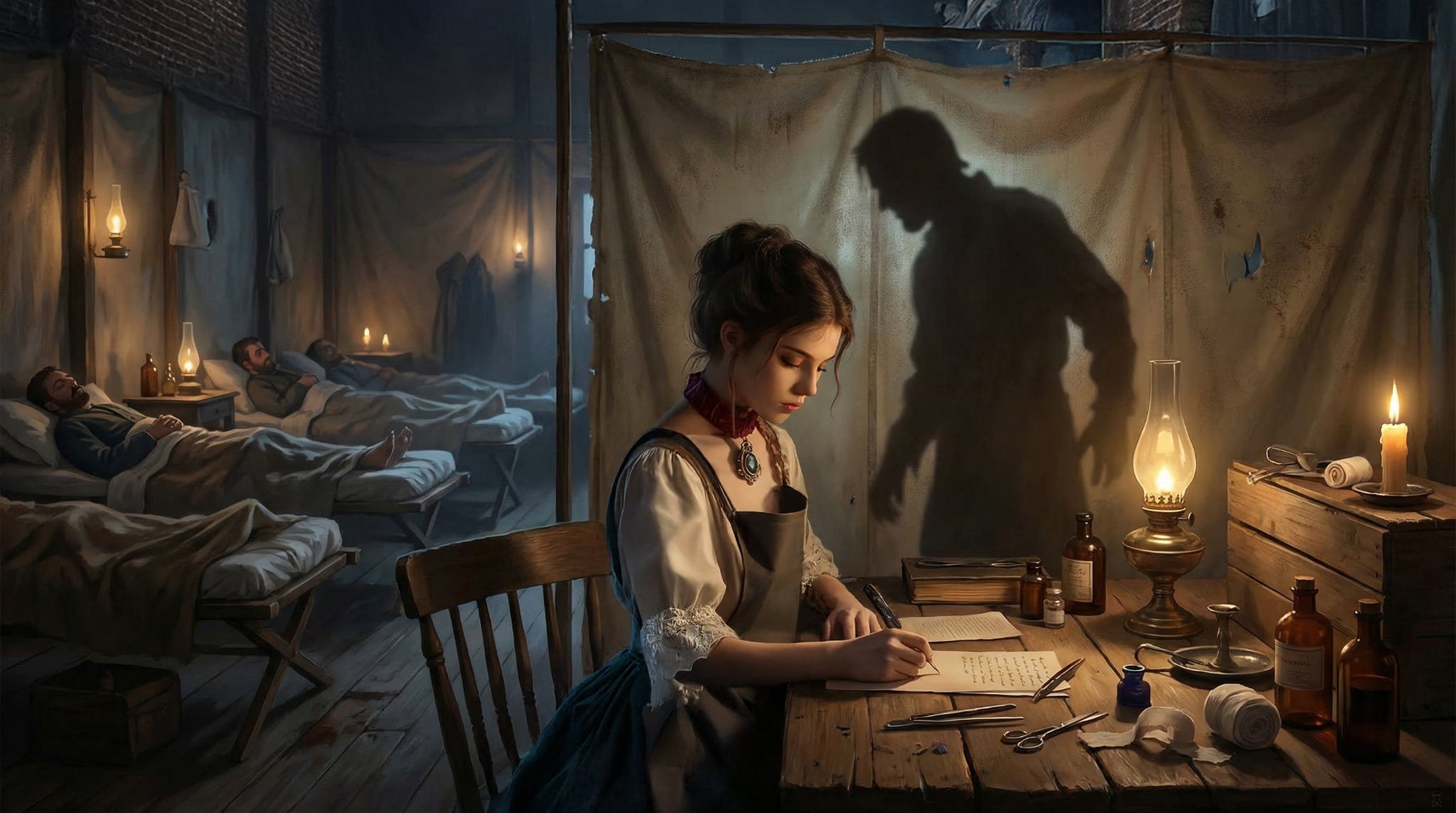
The fever ward itself has become familiar territory—a dedicated section of the factory floor funded by Father’s benefactors and separated from the general hospital by heavy canvas curtains. Within our section, lighter canvas partitions divide patient spaces.
I navigate between these hanging screens with ease, recognize each patient by their breathing patterns alone, can identify which orderly approaches by the sound of their footsteps on the factory floor. The space has transformed from frightening vastness to intimate workspace where I move with confidence born of experience.
Some of the most severe cases occupy partitions farthest from the main entrance—isolated due to the violent nature of their symptoms. Other volunteers refuse to approach these patients without armed escort, yet I tend them twice daily without incident. They respond to my voice, I have noted, with a degree of calm they show no other person. When I speak gently while administering medicine, the terrible tension in their frames eases. Their eyes, though clouded with fever, fix upon my face with something approaching recognition.
“You have an effect on them,” Dr. Merriweather remarked when he observed this phenomenon. “The severe cases seem responsive to you where they show others only aggression. Even Henderson, who barely survived that terrible attack weeks ago, calms under your ministrations.”
“Perhaps they sense my lack of fear,” I suggested, though I confess uncertainty about this explanation.
“Perhaps they sense something else entirely.” His expression grew thoughtful, the way it always does when he considers medical mysteries. “Your constitution may produce some subtle influence that calms their agitation.”
The notion intrigued me, and I have begun documenting patient responses to various volunteers. The patterns I am discovering prove fascinating. Where Mrs. Patterson’s presence increases patient distress—elevated heart rates, visible anxiety, sometimes violent outbursts—my approach produces the opposite effect. Heart rates steady. Breathing calms. Even the most agitated patients grow quiescent under my care.
I mentioned these observations to Dr. Merriweather during this afternoon’s consultation. He listened with such intense focus that I grew self-conscious, wondering if my theories sounded foolish to his educated ear.
“Not foolish at all,” he said when I finished. “Your observations align with certain hypotheses I have been developing. The affliction may respond to constitutional factors we do not yet understand. Your particular physiology might produce calming influences on afflicted patients.”
“You mean my presence itself provides therapeutic benefit?”
“Precisely. Though the mechanism remains unclear.” He paused, studying me with that penetrating gaze I have come to expect during our more theoretical discussions. “Eleanor, how do you feel when treating the most severe cases? Physically, I mean. Do you experience any unusual sensations?”
I considered the question carefully, examining my own responses with the same analytical attention I apply to patient observation.
“I feel... energized,” I admitted. “The more severe the case, the more vital I become. My senses sharpen. My thinking clarifies. I perceive details I might otherwise miss.”
“Interesting.” He made a note in his ever-present journal. “And this vitality—does it fade when you leave the ward?”
“Somewhat. Though less than formerly. I used to feel quite depleted after a long shift. Now the energy sustains itself for hours afterward.”
“Remarkable.” Another note, his pen moving with swift precision. “Your body has adapted to the environment in beneficial ways. The sustained exposure has strengthened rather than weakened your constitution.”
The explanation satisfied me, though I confess some part of my mind questions whether “adaptation” fully accounts for the changes I have noticed. The heightened senses. The reduced need for sleep. The way sounds and scents have grown more distinct, as though a veil has lifted from my perceptions.
Even now, writing by candlelight in Dr. Merriweather’s office—he has granted me use of this private space for completing my documentation—I perceive details that should escape notice. The individual wax drips on the candle holder. The grain pattern in the wooden desk. The faint scent of carbolic acid lingering from this afternoon’s wound cleaning, though the solution was applied three rooms distant.
I hear conversations from the main ward with startling clarity. Nurse Williams discussing ration distribution with an orderly. Private Henderson’s labored breathing from his partition near the south wall. The scurry of rats in the factory’s upper galleries, their tiny claws scratching against wooden beams.
No. That cannot be accurate. The upper galleries stand fifty feet above us, and rats make very little sound. Surely I imagine this enhanced perception, attributing to literal hearing what must constitute educated guess based on knowledge of the building’s infestation problems.
Yet I hear them distinctly. Four rats, I would judge from the pattern of sounds. One larger, three smaller. Moving along the eastern beam toward the nest they have established in the far corner.
Dr. Merriweather would find this observation fascinating, I suspect. Or concerning. I am uncertain which. Perhaps I shall mention it during tomorrow’s consultation, framed as speculation rather than certainty.
He values my analytical thinking, but I would not wish him to question my soundness of mind.
to be continued…
© 2025-26 E.M.V. - writing as Morgan A. Drake & Joe Gillis. All rights reserved.