

Beautifully Dead - Chapter 33
An Immortal Affections serialized novel


From Eleanor’s Caldwell Private Journal
Everett House, Richmond
March 8, 1862
Late Evening
By nine, the ward has settled into its evening rhythm. Most severe cases receive their sunset doses of iron tonic between seven and eight o’clock, a schedule we have found reduces overnight disturbances. I completed those rounds an hour ago, administering medicine to twelve patients in rapid succession. Henderson sleeps fitfully tonight, his fever diminished somewhat by today’s treatments. Morrison accepts water with trembling hands, his appetite still absent but the violent nausea finally subsiding. The efficiency of my movements surprised even myself—I scarcely needed to pause between patients, my hands moving through the necessary preparations with speed that suggested long practice rather than mere weeks of experience.
“You move as though you’ve been doing this for years,” Nurse Williams remarked, watching me prepare Private Morrison’s dose while simultaneously checking Private Henderson’s pulse and noting the time on my pocket watch.
“The routine has become second nature,” I replied, though her observation pleased me. To achieve such competence in mere weeks speaks to dedication and natural aptitude both.
Only one matter troubles my otherwise satisfactory progress. A new patient arrived this afternoon, transferred from a field hospital with documentation describing him as “extraordinarily dangerous” and “requiring armed restraint.” Private Matthews. The orderlies who transported him spoke in subdued tones about violence at the field hospital, though details remained vague, especially in front of the young nurses.
Dr. Merriweather examined the documentation with grave expression, then turned to assign Matthews’s care. I stepped forward before he could speak.
“I should observe this case,” I said, keeping my voice steady despite trepidation fluttering in my breast. “The severity presents valuable opportunity for systematic study.”
He regarded me with that penetrating look I have come to recognize—concern for my safety wrestling with respect for my capabilities. “Eleanor, this patient is extraordinarily dangerous. The field hospital specifically warned against approaching him without proper restraint measures in place.”
“You have trained me for precisely such cases,” I said. The words emerged with more confidence than I felt. “My observations of progressive stages have been thorough. I am prepared.”
The silence stretched between us. Other volunteers had paused in their duties, watching this exchange with undisguised interest. Mary Catherine’s expression held something between horror and vindication, as though my volunteering for dangerous duty confirmed her low opinion of my judgment.
“Very well,” Dr. Merriweather said finally. “You will follow protocol absolutely. No deviations, regardless of what scientific curiosity might suggest.”
“Of course.” Relief and anticipation mingled in my chest. To observe such an advanced case—the documentation possibilities alone justify any risk.
Matthews occupies the isolation partition in the far corner of our fever ward—a space separated by double canvas screens to contain the most dangerous cases. He lies restrained with leather straps across chest, wrists, and ankles. I approached his space during evening rounds, maintaining the careful distance proper caution requires. His eyes tracked my movement with unsettling focus. Not the vacant stare I have observed in other afflicted patients. Something more aware. Calculating.
“Private Matthews,” I said gently, noting his responses in my mental catalog for later transcription. “I am Miss Caldwell. I shall be assisting with your care.”
No verbal response. His eyes remained fixed on my face, pupils widely dilated despite the low gaslight. The restraints creaked as tension passed through his frame, muscles flexing against the leather bindings.
I checked the security of the straps—all tight, all properly buckled. His pulse, when I pressed fingers against his wrist, hammered with alarming rapidity. Nearly one hundred and forty beats per minute, I estimated. Fever had flushed his skin, though he showed none of the typical signs of fluid deficiency. Indeed, he appeared almost robust, as though the fever energized rather than depleted him.
“You must take your iron tonic,” I said, reaching for the dose I had prepared. “It will ease your symptoms.”
For the first time, he spoke. A single word, barely audible: “No.”
The clarity of it startled me. Other afflicted patients lose coherent speech within days of fever onset. Matthews had been symptomatic for nearly a week according to his documentation, yet retained sufficient reasoning powers for refusal.
“The medicine will help,” I persisted. “I have seen it provide relief to many patients with symptoms similar to yours.”
His eyes narrowed. “You smell different.”
The observation froze me in place. “I beg your pardon?”
“Different from the others. You smell...” He inhaled deeply, nostrils flaring. “...familiar.”
Unease rippled through me. This degree of awareness surpassed anything I had previously documented. I made a mental note to inform Dr. Merriweather immediately after completing rounds.
“I shall return with your evening dose,” I said, maintaining professional composure despite my discomfort. “Please try to rest.”
His gaze followed me as I departed, intensity undiminished even when I moved beyond his sight line. I felt his attention as tangible weight upon my shoulders, as though his awareness extended beyond normal sensory limitations.
The sensation troubled me sufficiently that I sought Dr. Merriweather in his office immediately after completing the remaining evening rounds.
“Matthews displayed unusual lucidity,” I reported. “He spoke coherently, recognized my presence as distinct from other staff, and made observations about...” I hesitated, uncertain how to phrase the peculiarity without sounding absurd. “...about my scent.”
Dr. Merriweather’s expression grew very still. “What precisely did he say?”
“That I smell different from the others. Familiar.” The words sounded foolish spoken aloud. “I suspect fever has heightened his sense of smell, creating false impressions of familiarity where none exist.”
“Perhaps.” But his tone suggested he found my explanation insufficient. “Eleanor, I want you to exercise extreme caution with Matthews. More so than with any previous patient.”
“He is properly restrained—”
“Restraints have failed before.” His voice held a sharp edge I had not previously heard. “With patients in advanced stages, normal physical constraints no longer apply. Strength increases. Awareness heightens. They become capable of things that should prove impossible.”
“You believe Matthews could escape his restraints?”
“I believe,” he said carefully, “that Matthews represents the most dangerous case this ward has yet encountered. Your usual confidence serves you well with ordinary patients. With him, it could prove fatal.”
The warning should have frightened me. Instead, I felt that familiar surge of scientific fascination. A patient so advanced he could potentially overcome physical restraint? The observations I could gather from such a case would prove invaluable.
“I shall maintain appropriate caution,” I assured him. “But I would very much appreciate the opportunity to continue observing his progression.”
Dr. Merriweather studied me for a long moment. “Your dedication to research sometimes concerns me, Eleanor. There exists a point where scholarly interest crosses into recklessness.”
“I am aware of the risks—”
“Are you?” He moved closer, his expression intent. “You have worked here forty days. Documented dozens of cases. Developed theories about progression and treatment. But you have never witnessed what I have witnessed. Never seen what these afflicted patients become when restraints fail and hunger overcomes all remaining humanity.”
The intensity of his words gave me pause. “What have you witnessed?”
“Things I would prefer you never experience firsthand.” He placed a hand on my shoulder, the gesture almost paternal. “Promise me you will not approach Matthews without another staff member present. Promise me you will trust my judgment when I say certain risks exceed any potential research value.”
I wanted to argue. Wanted to insist that proper scientific observation required accepting calculated risks. But the gravity in his expression stopped me.
“I promise,” I said, though the words felt constrictive.
“Good.” His hand dropped away. “Now go home. You have been here since before dawn. Even your remarkable constitution requires rest.”
I gathered my things, preparing to depart for Sarah’s house. The church bells tolled ten as I crossed the factory floor, my footsteps echoing in the vast space. Most patients had settled for the night, their breathing creating a rhythmic chorus of inhalations and exhalations that I could distinguish individually despite the canvas partitions separating them. Henderson’s labored breathing from his partition near the south wall. Morrison’s quieter respiration from the eastern section.
Matthews remained wakeful. I heard him shifting against his restraints, the leather creaking with each movement. Heard his breathing—deeper than the others, more controlled. Heard him whisper something too low for ordinary hearing to detect.
Yet I heard it.
“Tomorrow.”
Just that single word. Tomorrow.
I should have reported this to Dr. Merriweather. Should have documented the observation immediately in my notes. Instead, I found myself hurrying toward the exit, suddenly eager to escape Matthews’s unsettling awareness.
The night air struck cold against my face after the ward’s stifling atmosphere. I drew deep breaths, trying to shake the unease that had settled in my chest. Tomorrow I would maintain proper distance from Matthews. Would follow Dr. Merriweather’s protocols without deviation. Would remember that research value never justifies endangering one’s safety.
Tomorrow I would exercise appropriate caution.
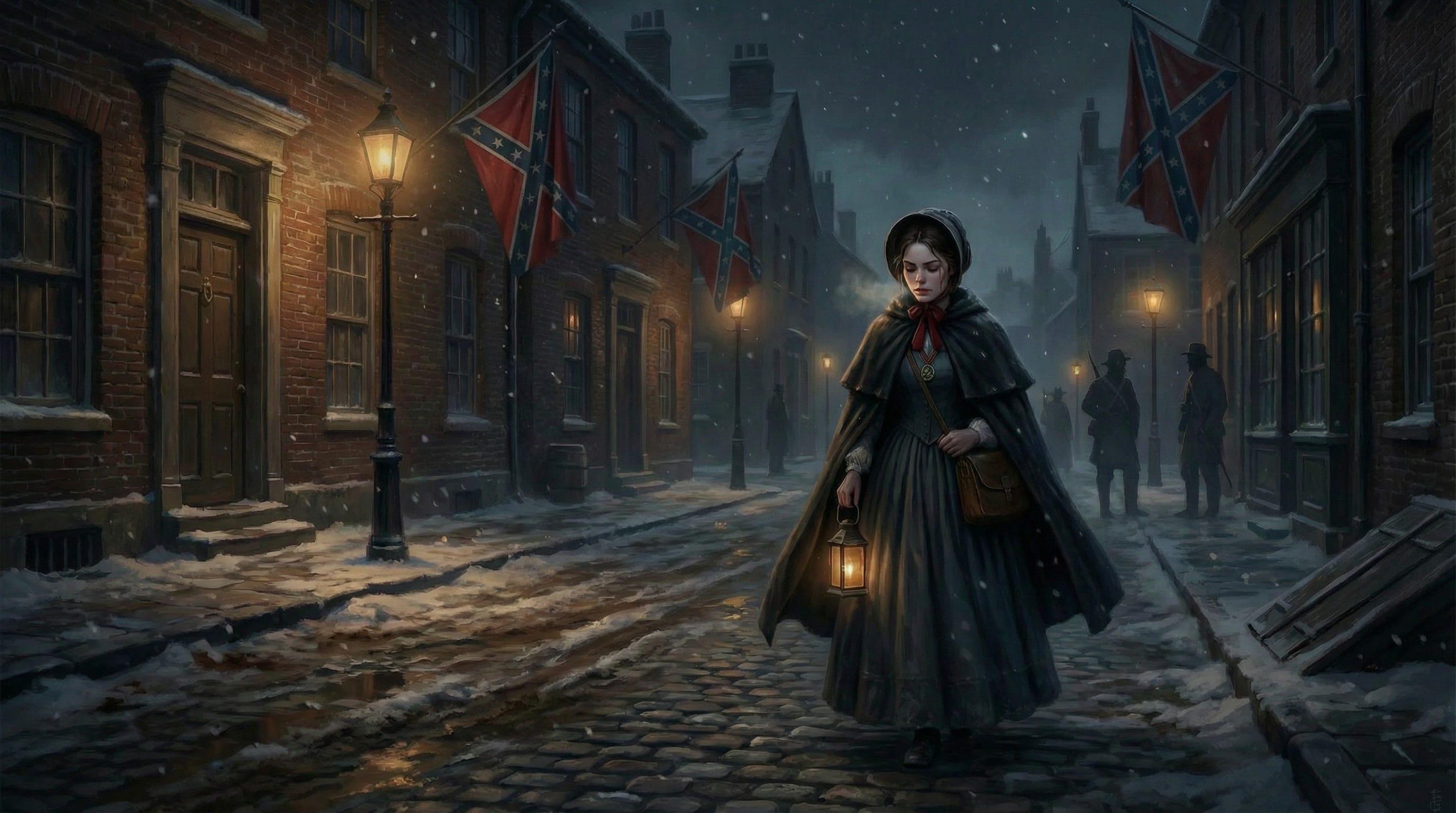
Tonight, walking through Richmond’s dark streets toward Sarah’s house, I could still feel Matthews’s gaze upon me. Could still hear that whispered word echoing in my thoughts.
Tomorrow.
The moon hung above the city in a slender crescent, its weak light barely illuminating my path. I walked quickly, eager to reach the safety of familiar walls and Sarah’s comfortable presence.
Behind me, the hospital’s hulking silhouette dominated the skyline, windows glowing with lamplight from the wards where volunteers kept overnight watch. Somewhere in those partitioned spaces, Matthews lay restrained, counting hours until tomorrow.
Whatever tomorrow might bring.
I cannot explain the foreboding that grips me as I write these final words. Surely mere nervousness about a challenging case, amplified by Dr. Merriweather’s unusual warnings. Tomorrow I shall laugh at tonight’s unease, shall document Matthews’s case with the same scientific detachment I apply to all my observations.
Tomorrow.
The word seems to echo in my mind with each stroke of this pen.
Tomorrow I shall prove myself worthy of Dr. Merriweather’s trust. Shall demonstrate that my dedication to research does not preclude appropriate caution. Shall observe Matthews with professional distance while maintaining every safety protocol.
Tomorrow.
The bells toll eleven. My hand aches from writing, and Sarah surely wonders at my late return. I should conclude this entry, retire to my room, attempt to sleep despite the strange energy that continues to course through my veins.
Tomorrow begins in seven hours. I shall face it with the same confidence that has served me throughout these past forty days.
The candle burns low. Time to extinguish it and seek my bed.
Tomorrow.
to be continued…
© 2025-26 E.M.V. - writing as Morgan A. Drake & Joe Gillis. All rights reserved.