

Beautifully Dead - Chapter 34
An Immortal Affections serialized novel


From Eleanor’s Private Journal
Dr. Merriweather’s Private Office
Richmond Confederate Hospital
March 9 and 10, 1862
Previous page torn, ink heavily blotted
My hands shake so violently I can scarce control this pen. The letters waver and blur before my eyes, though whether from trembling or tears I cannot determine. I write by candlelight in Dr. Merriweather’s private office, where he has confined me for my own safety and that of others. What I must record defies comprehension. Yet the scientific mind within me demands documentation even as terror threatens to overwhelm all rational thought.
I was attacked.
The words appear almost absurd written thus. Some melodramatic fiction rather than fact. Yet their truth is undeniable. Private Matthews broke free of his restraints and attacked me with violence I could never have anticipated despite all my careful observations.
Let me attempt to reconstruct the sequence of events with such accuracy as my disordered mind permits.
The attack occurred perhaps ninety minutes past. Time has grown strange and elastic in ways I cannot fully articulate. I had completed my evening rounds and prepared to depart for Sarah’s house. The church bells had tolled eleven. Most patients slept or rested quietly in their partitions. The night orderly, having arrived to assume his watch duties, was making his own initial rounds in the main ward sections.
I should have waited to walk through with him. Dr. Merriweather had warned me explicitly never to approach Matthews without another staff member present. Yet I had also promised to follow protocol absolutely, and protocol dictated a final check of all severe cases before departing the ward.
One final check.
Dear God, how those words mock me now.
I approached Matthews’s isolation partition in the far corner of the fever ward. The double canvas screens that separated his space from the general ward hung still in the factory’s motionless air. No sounds emerged from within. No moaning, no restless movement against restraints. Perfect silence.
The quiet should have warned me. The other afflicted patients never achieve such stillness. They thrash and mutter through fevered sleep, their bodies in constant agitation. Matthews’s silence suggested either improvement or some change I had not previously documented.
Curiosity overcame caution. I parted the canvas screen and stepped inside his partition.
He appeared to sleep. His eyes were closed, his breathing deep and regular. The restraints across his chest, wrists, and ankles remained properly secured, or so they appeared in the dim gaslight. I noted these observations with satisfaction, already composing the entry I would make in my documentation. “Subject achieved restful sleep on third evening of isolation. Possible indication of fever breaking.”
I moved closer to check his pulse.
The restraint across his chest had loosened. I could see the buckle mechanism had worked partially free, perhaps from his earlier struggles against the leather. A simple adjustment would secure it properly. I reached out to tighten the strap.
My fingers had scarce touched the leather when—
The movement was so rapid I cannot reconstruct the sequence with accuracy. One moment the restraints appeared secure. The next, his hand had closed around my wrist with strength that ought to be impossible for a man in such weakened condition. The grip was iron itself, crushing, inexorable. He jerked me downward with such force that I felt something tear in my shoulder even before his other arm—somehow free of its binding, though I know not how—seized me and pulled me closer still.
I tried to scream. Managed only a strangled gasp before his hand covered my mouth, pressing so hard against my jaw that I tasted blood where my teeth cut into my inner cheek.
His face was inches from mine. His eyes wide open now, fixed on me with terrible focus. No human recognition remained. Only hunger. Vast and bottomless and utterly without mercy.
Then he bit me.
Pain.
Such an inadequate word for the sensation of human teeth tearing through fabric and flesh both. The sound—dear God, the sound will haunt me until my dying day. Wet and tearing and utterly savage. His teeth struck my brooch first—the one Thomas gave me before departing. The choker ribbon tore under the force of the attack, the brooch falling away and clattering onto the floor. Without its protection, his teeth found my flesh directly, sinking deep into the muscle at the base of my neck.
I tried to scream again. His hand still covered my mouth, muffling the sound to nothing. The agony was immediate and overwhelming. White-hot fire radiating from the wound site through my entire body. Each attempt to struggle drove his teeth deeper, his jaw working with terrible purpose.
His throat moved. Swallowing.
No.
I cannot write that. Cannot acknowledge what my senses perceived in that moment. Cannot admit that I felt—
The orderlies came then. Thank Providence they came. The moments before their arrival stretched into eternities of agony and terror. His jaws remained locked at the base of my neck as I struggled, each movement driving them deeper. His hand crushed my jaw.
I heard shouting. Footsteps pounding across the factory floor. The canvas screens torn aside. Then hands grasping Matthews, pulling at him. Four men straining to break his hold.
He would not release me.
They struck him. Wrestled him. Used their combined strength against his fevered frame. Still he would not release his grip, his jaw locked with inhuman determination. I felt the tissue tearing further as they pulled us apart, felt warm blood streaming down my chest and soaking through my dress.
Finally they broke his grip. I collapsed to the floor, my hand instinctively clutching at the wound. Blood pulsed between my fingers with each beat of my heart. The edges of the torn flesh felt ragged, irregular. I pressed harder, trying to staunch the flow, but the bleeding continued with alarming rapidity.
They struggled to restrain him as he snarled and snapped, his face covered in my blood. Strings of it dripped from his chin. His eyes remained vacant, consciousness utterly absent, only that terrible hunger animating his actions.
I had seen that expression before. Documented it in my notes. “Subject displays no recognition of surroundings or persons. Actions driven entirely by physiological compulsion.”
Now I was the subject of that compulsion. My blood stained his mouth.
My detached observation felt obscene in the circumstances, yet I could not prevent my mind from cataloging details. Even as I bled upon the factory floor, even as orderlies fought to control my attacker, some part of my consciousness continued its work, unbidden.
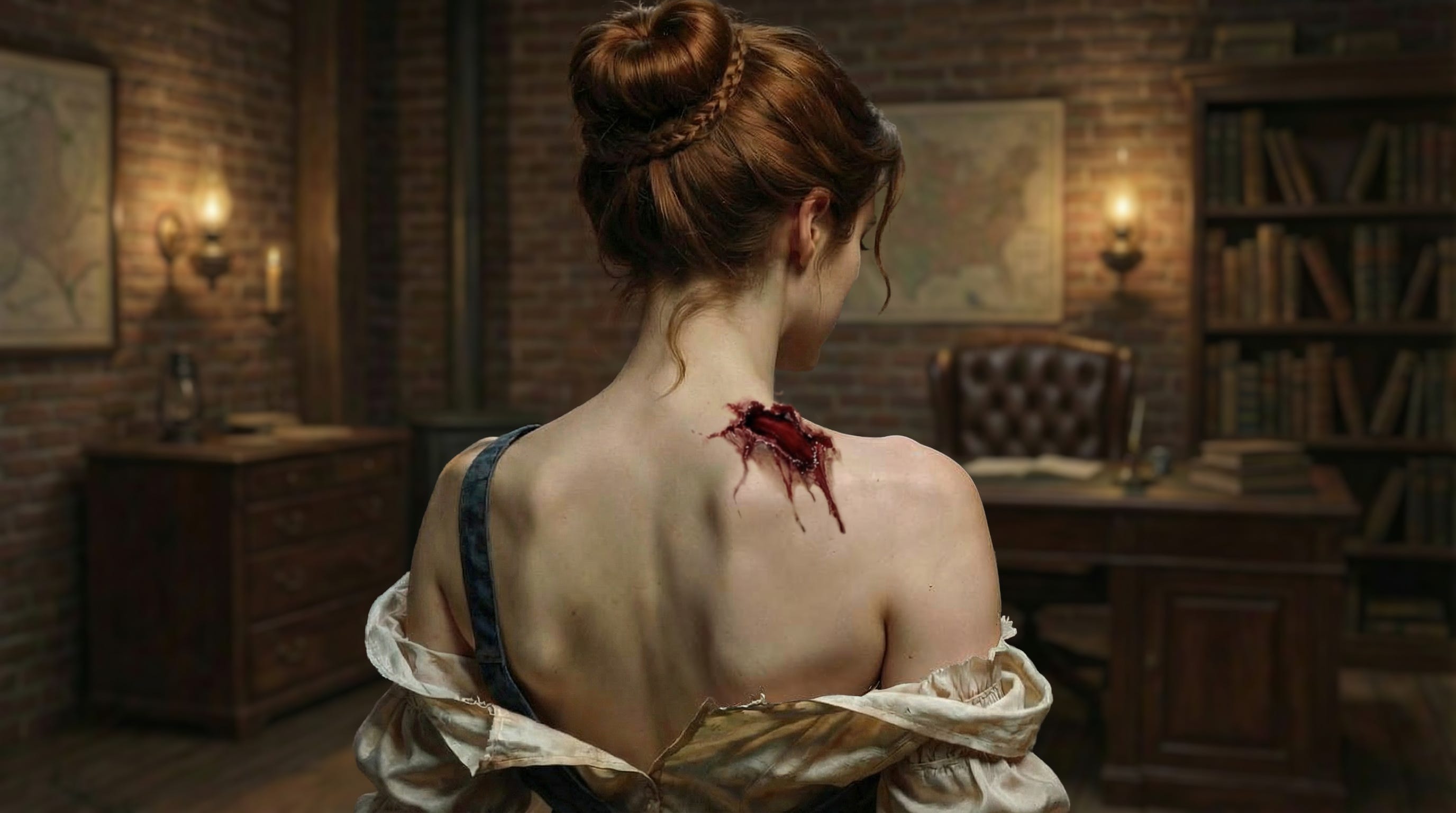
The wound measured approximately four inches in length—a ragged crescent positioned at the base of my neck, perhaps two inches above my collarbone, the juncture where neck meets shoulder. The brooch had redirected the bite lower than his initial angle. Depth significant—I could feel the damage extending through several tissue layers. The bleeding remained profuse though mercifully not arterial. Pain severe but bearable, given the circumstances.
“Miss Caldwell!”
Dr. Merriweather’s voice cut through the chaos. I looked up to see him rushing through the partitions, his face terrible with fury. When he reached my side and saw the wound, saw the extent of damage Matthews’s attack had inflicted, rage transformed his features into something I had never witnessed.
“Get him to isolation!” he roared at the orderlies. “Chain him! Iron restraints this time! If he breaks free again, I will put a bullet through his skull myself!”
The violence of his words shocked me almost as much as the attack itself. Dr. Merriweather, always so controlled, so measured, now shaking with wrath that seemed directed as much at himself as at Matthews.
He turned to me, and the fury drained away, replaced by something worse. Anguish. “Miss Caldwell.” Clearly trying to attract my attention. “Eleanor. Can you hear me?”
“The bleeding is substantial but manageable,” I heard myself say, as though discussing some stranger’s injury rather than my own. “The tissue damage extends approximately four inches at the base of the neck. Depth difficult to assess given current hemorrhaging, but I believe the subcutaneous layer compromised, while deeper structures remain intact. The choker prevented direct access to the major vessels.”
My voice sounded remarkably steady. Clinical. Detached.
He stared at me for a long moment. Horror showed plain on his face. Despair so profound it aged him by years. And beneath both, something that might have been terrible confirmation.
“The wound must be treated immediately,” he said, his voice rigidly controlled. “Can you walk to my office?”
“Yes.” The word emerged steadier than I felt. “I can walk.”
Only then did I notice the night orderly standing frozen nearby, his face white with shock. And beyond him, Mrs. Coleman emerging from one of the general ward partitions, drawn by the commotion. Her eyes widened as she took in my bloodied state.
Heat flooded my face despite the circumstances. Here I stood, dress torn and soaked with blood, alone with men in the midnight hours. No chaperone. No propriety. The scandal would be absolute.
Yet even as mortification pierced through shock, pragmatism asserted itself. I was bleeding from a savage wound inflicted by a fevered patient. Social convention mattered less than survival. Mrs. Coleman’s opinion of my reputation paled beside the necessity of immediate medical treatment.
“Mrs. Coleman,” Dr. Merriweather said with sharp authority, “you will speak of this attack to no one outside hospital staff. Miss Caldwell was injured in the performance of her duties. That is all anyone needs to know.”
She nodded mutely, still staring.
“Now return to your patients.” His tone brooked no argument. “There is nothing you can do here.”
She fled.
The journey across the factory floor seemed endless. Each step sent fresh pain lancing through my shoulder and neck. I could feel warm blood still seeping from the wound despite the makeshift pressure bandage one of the orderlies had tied in place. The gaslight seemed unnaturally bright, each flame distinct and sharp-edged in ways that made my eyes water.
Dr. Merriweather maintained a supporting hand under my uninjured arm, his touch proper but his face grim. Behind us, I heard Matthews being dragged away, still fighting his captors despite their superior numbers. The sounds of that struggle echoed through the factory’s vast heights.
His private office felt smaller than it usually did. He seated me in the chair beside his desk, then moved quickly to gather supplies. Carbolic acid for disinfection. Clean linen for bandaging. The cauterizing iron, already heating in the small brazier he kept for sterilizing instruments.
“I must examine the wound properly,” he said, his back still to me. “With your permission, I need to... you must remove the upper portion of your dress.”
More heat flooded my face. A gentleman physician examining an unmarried woman’s unclothed shoulder violated every social propriety. Yet necessity overrode convention.
“Of course,” I managed. “Do whatever is medically necessary.”
I reached behind to unfasten the buttons running down the back of my bodice. My right arm would not cooperate fully—the torn muscle made reaching difficult and sent fresh pain through the injury. I managed perhaps three buttons before my fingers began to tremble too violently to continue.
“I cannot—” My voice broke despite my efforts at composure. “The buttons. I cannot reach them properly.”
He turned then, and I saw his face had gone very pale. “Of course. Forgive me. I should have realized.”
He moved behind me, his hands steady as he worked the remaining buttons free. His touch remained absolutely clinical, yet I felt my face burning hotter with each fastening that gave way. The bodice loosened, allowing me to slide my right arm free of the sleeve. The fabric stuck to the wound, dried blood making the separation agonizing. When it finally pulled away, fresh bleeding began anew.
Dr. Merriweather came around to face me again, his eyes fixing on the injury itself rather than my state of undress. Some small part of me felt grateful for his professionalism even as I sat there in nothing but my bloodstained chemise and the loosened dress gathered at my waist.
The wound looked worse exposed to lamplight. A ragged crescent of torn tissue positioned low on my neck, perhaps two inches above my collarbone. Blood still welled from the deepest portions. Around the wound’s edges, I could see the clear impressions of individual teeth.
“Your necklace,” Dr. Merriweather said quietly, examining the injury. “It redirected his bite downward. If he had achieved his initial angle...” He did not finish the sentence.
We both understood. If Matthews had bitten higher on my neck, he would have found the great vessels. I would have bled to death before help arrived.
“Where is it?” I asked. “The brooch. It fell during the attack.”
“I have it here.” He produced the small piece from his pocket. The glass face appeared intact despite the violence, though the ribbon choker had torn completely. “I retrieved it from the floor. The metal frame is bent where his teeth struck it.”
I reached for it with my left hand, my fingers closing around the familiar shape. “Keep this close,” Thomas had said.
“Tom… Thomas should have this returned to him. Whatever becomes of me.”
Dr. Merriweather’s hands stilled in their preparation of the carbolic solution. “Eleanor—”
“He should have it,” I insisted. “Promise me you will see it reaches him. Regardless of what becomes of me.”
After a long moment, he nodded. “I promise.”
He began cleaning the area with carbolic solution. The chemical sting barely registered against the deeper agony of damaged tissue. His hands were steady as he worked, but I could see the tension in his jaw, the muscle jumping beneath the skin.
“This will be painful,” he said, reaching for the cauterizing iron. Its tip glowed orange-red in the brazier’s heat. “I can offer laudanum—”
“No.” I shook my head. “I must remain alert. Must observe my own responses. This represents an unprecedented opportunity for medical documentation. Whatever the outcome, my impressions of the progression could prove valuable to future practitioners. Could help others. Could constitute a real contribution to medical knowledge.”
His expression grew very still. “Eleanor. You need not—”
“I must.” My voice steadied with conviction. “You said my observations were valuable. That my documentation might advance understanding of these afflictions. If I am to be exposed, at least let that exposure serve some useful purpose. Let me document the process from the perspective of the afflicted themselves. Such an account has never been recorded.”
He studied my face for a long moment. Then nodded, accepting my determination if not approving it. “Very well. But if the pain becomes unbearable—”
“Then I shall inform you.” I gripped the arms of the chair, bracing myself. “Please, proceed.”
The cauterizing iron descended toward torn flesh. I fixed my eyes on the wall beyond Dr. Merriweather’s shoulder, counting breaths, preparing for what would come.
The pain transcended anything I had previously experienced. Fire seared through muscle and nerve both, burning away blood and infection and living tissue in one terrible instant. The smell—charred meat and carbolic and something acrid I could not name—sent bile rising in my throat.
I grabbed the wadded fabric of my ruined dress and bit down hard on the blood-stiffened cloth. The scream that tore from my throat became muffled against the fabric. My vision tunneled to a small point of light surrounded by darkness. Sweat broke across my forehead, my back, soaking through what remained of my chemise.
“Breathe,” Dr. Merriweather commanded. “Child, breathe.”
I could not respond. Could only draw desperate, shuddering gasps through my nose while my teeth remained locked on the fabric. My entire body shook violently. Nausea rolled through me in waves.
He paused, the iron still glowing in his hand. “Can you continue?”
I managed a jerky nod, unable to release the dress from my mouth. Unable to speak. I raised one trembling hand and motioned forward. Continue. I would endure this. I must.
The second application of the iron made my vision go completely black for several seconds. I heard myself making sounds—animal sounds, wordless and terrible—muffled by the cloth between my teeth. My hands gripped the chair arms so tightly I felt the wood creak. Sweat poured down my face, my neck, pooling in the hollow of my collarbone.
“Two more,” Dr. Merriweather said quietly. “You’re doing remarkably well. Two more and it’s finished.”
The third cauterization. The fourth. Each one an eternity of fire. By the final application I could no longer sit upright without his steadying hand on my uninjured shoulder. The dress fell from my mouth, too saturated with saliva and blood from where I had bitten through my own lip despite the fabric barrier.
When he finally set aside the iron, I sagged forward, nearly tumbling from the chair. He caught me, holding me steady while my body convulsed with delayed shock. I retched once, twice, but my empty stomach produced nothing but bile that burned my throat.
“Finished,” he said gently. “It’s finished now. We are done.”
I could not speak. Could only tremble and gasp and press my good hand against my mouth, fighting the nausea that threatened to overwhelm me entirely. Sweat drenched my chemise. My hair clung to my face and neck in wet strands.
He applied the bandages while I sat there shaking, unable to assist or even hold myself fully upright. His hands remained steady while mine would not stop trembling.
“You did well,” he said quietly, securing the final bandage. “That would have broken most people.”
I still could not speak. Could only nod weakly, my breath still coming in shudders.
Mrs. Coleman appeared shortly after with clean clothing—a simple house dress and fresh undergarments she had gathered from the nurses’ stores. She kept her eyes averted as she set the bundle on the chair, her face pale. Dr. Merriweather thanked her quietly and sent her away before she could speak.
He stepped outside while I changed with fumbling, painful movements. My own dress lay in a blood-soaked heap on the floor, ruined beyond salvaging. The chemise was equally destroyed.
I managed the fresh garments with difficulty, my right arm nearly useless. The house dress fastened in front, thank Providence. Small mercies amid catastrophe.
When Dr. Merriweather returned, he gestured to a narrow cot against the far wall. “You will remain here. The door will be locked from outside. The windows are already covered. I will bring candles and water.”
“I understand.” I did understand. Quarantine. Containment. Protection for those who remained uninfected. “What message shall be sent to Sarah?”
His hesitation spoke volumes. “What would you have me tell her?”
“That I have been exposed to the fever.” The lie came easily, born of necessity. “That I must remain isolated until the danger of contagion passes. That she should not visit or attempt communication. That I am well cared for and she need not worry.”
“She will worry regardless.”
“Better worried than infected.” I met his eyes. “You know what may become of me, Dr. Merriweather. What likely will become of me. Sarah and little Charles must be protected from that.”
After a long moment, he nodded. “I will send word at first light.”
He moved toward the door, then paused with his hand on the latch. “Eleanor... I am sorry. More sorry than you can possibly comprehend. I should never have allowed you near Matthews. Should have insisted on stricter measures. This is my failure, not yours. My pride in your abilities blinded me to the danger. I am responsible for what has befallen you.”
The words held such genuine anguish that tears pricked my eyes for the first time since the attack.
“You trained me well,” I said softly. “Too well, perhaps. My own curiosity and pride led me into danger, not your instruction. I chose to approach Matthews alone. I chose to ignore your warnings. The fault is mine.”
His expression suggested he did not believe me. But he said nothing more, only stepped through the door and locked it behind him with that terrible final click.
And I was alone.
-
I am alone still, writing these words by candlelight in the small hours of morning. Dawn cannot be far off. I hear the city beginning to stir beyond the covered windows. Cart wheels on distant cobblestones. Early merchants opening their shops. The hospital itself remains mostly quiet, though I hear occasional footsteps in the corridor outside.
Sleep proved impossible despite my exhaustion. The wound throbs with each heartbeat, a constant reminder of what has occurred. My mind races too quickly for rest, cataloging sensations and symptoms with the same compulsion that has driven my medical documentation these past weeks.
I should feel fevered by now. Should feel the heat rising in my blood. Yet I feel no fever. Only the wound’s pain and a bone-deep weariness that might be shock or blood loss or simple exhaustion.
But speculation serves no purpose. I must document what occurs, not what I fear might occur.
-
I attempted sleep as dawn broke. Exhaustion finally overcame pain and anxiety, though I woke several times from dreams I could not remember, drenched in cold sweat.
The orderly brought breakfast perhaps two hours past dawn. Weak tea and toast. The sight of food produced only nausea—not hunger, something closer to revulsion. I managed three sips of tea before setting it aside. Henderson refused all food by his second morning post-exposure.
I do not wish to think about Henderson. About what he became.
-
The fever began near midday.
I felt it first as unusual warmth spreading through my chest, then radiating outward into my limbs. Not unpleasant, initially. Almost soothing after hours of pain and cold shock. But the warmth built steadily, degree by degree, until I recognized it for what it was.
Dr. Merriweather examined me when I called for him, pressing his hand against my forehead, my neck, checking my pulse with grave concentration.
“One hundred and two degrees,” he said quietly. “It has commenced.”
“How long?” The question emerged before I could stop it. “How long do I have? Will I retain my mind, or will I become as they are?”
He settled into the chair beside my cot, his expression carefully neutral. “The progression varies, you know that as well as I do. Furthermore, you have been exposed for weeks. Your body may have adapted in ways that offer protection. Or the sustained exposure may have made you more vulnerable. I simply do not know.”
His pause stretched too long before he continued. “You have observed how the few who survive this affliction emerge profoundly changed from it. Even if consciousness persists, you will not be as you were. Or...” He stopped.
“Or I’ll be dead.” I finished the thought he could not voice. “I’ll survive and lose myself, or ‘ll lose myself and I will die.”
“Yes.” The word emerged barely above a whisper.
We sat in silence for a long moment. Outside, I could hear normal hospital sounds. Footsteps. Voices. The continuing business of caring for those who might yet be saved. Inside this locked room, we confronted possibilities neither of us wished to name.
“I want you to document everything,” I said finally. “Everything that occurs. Even after I lose the ability to document myself. Promise me you will maintain detailed observations of the complete progression.”
“Eleanor—”
“Promise me.” My voice steadied with conviction. “If I am to suffer this, at least let my suffering serve some purpose. Let the observations be thorough, accurate, useful to future medical understanding. Let something good emerge from this horror.”
His expression held such sorrow that fresh tears spilled down my cheeks despite my efforts at composure.
“I promise,” he said quietly. “I will document everything. Your observations and my own. A complete medical record from both perspectives.”
“Thank you.” I wiped at my eyes with trembling hands. “Now…There are letters I must write. Instructions I must leave. While I still possess the clarity to do so.”
He provided fresh paper and ink without question. “What do you need?”
“Letters to Thomas, to Sarah, to Papa.” The list formed as I spoke it. “Explanations and farewells in case the outcome proves fatal. Instructions regarding my personal effects. And...” I hesitated, then continued. “Again, a request that you send Thomas Everett the brooch with a lock of my hair added to his own beneath the glass. So he will have something of us both. So he will know we were together at the end, in some fashion.”
Dr. Merriweather’s hands tightened on the papers he held. “I will see it done. All of it. You have my word.”
“Then I shall begin.” I accepted the writing materials, arranging them on the small table beside my cot. “How long do I have before the fever worsens?”
“Hours, perhaps. Maybe longer given your unique circumstances.” He stood, preparing to depart. “Call if you feel your condition suddenly worsening. I will check on you regularly.”
After he left, I sat for a long moment staring at the blank paper. How does one write farewell letters when the outcome remains uncertain? How do I explain to Thomas what has occurred without revealing the full horror? How do I release him from our understanding without crushing him with despair?
The fever builds as I struggle with these questions. I can feel the heat mounting in my blood, my thoughts beginning to scatter like leaves in the wind. I must write quickly. Must set my affairs in order before coherence fails entirely.
But the words will not come. My hand shakes too violently. My vision blurs. The fever climbs higher with each passing moment.
Perhaps later. Perhaps when the heat subsides enough for clarity to return.
If clarity returns at all.
-
Evening
The fever burns. I write in fragments between waves of heat that rob me of rational thought. Dr. Merriweather checks frequently, bringing water I can barely swallow. He brought a lamp and left it for me on his desk, it pains my eyes now.
I think I asked him again. The question that haunts me through fever dreams. “Will I retain my mind?”
I think he told me, again, there might be a chance.
Or it might not.
The fever climbs. My thoughts fragment. I can feel my grip on self loosening degree by degree.
I am Eleanor Caldwell.
I am twenty-three years old.
I am promised to Thomas Everett.
Dear God, let me remember. Let me remain myself.
I must—
Entry becomes increasingly illegible—final words trail into incomprehensible scrawl
to be continued…
© 2025-26 E.M.V. - writing as Morgan A. Drake & Joe Gillis. All rights reserved.