

Beautifully Dead - Chapter 44
An Immortal Affections serialized novel


Private Journal of Miss Eleanor Marie Caldwell
Caldwell Residence, Richmond, Virginia
March 15th, 1862
I do not know how long I sat in that room after he told me. The window faced east, and by the time I walked out of that hospital — on my own two legs, which is a circumstance I find I cannot yet properly credit — the light had moved entirely. Whether I walked quickly or slowly I cannot account for. I have a poor record of the interval.
He told me I would not die.
He was very punctilious with that sentence. You will not die, Eleanor. And then, with that particular tone I have spent these months training myself to receive as wisdom, he told me what would be of me instead.
I cannot bring myself to set down the full title by which I have addressed him these three years. I cannot confer that respect — not yet, perhaps not again. The name carries too many mornings in that hospital, too many evenings receiving his instruction as though it were freely given. I will call him nothing in these pages. He is he. That will serve.
He told me why I had been chosen. My constitution, he said. What my blood had been doing since last autumn. And then I asked— keeping my voice entirely level, because I have learned from him how to be still when I need to think — I asked: since when.
He could not seem to finish that sentence cleanly. This is the only tell he possesses, I have decided. He speaks in complete sentences about everything else in this world. When he is telling less than the truth, the sentences lose their endings.
So I finished it for him. I asked about the winter. About the iron test in January, which he administered and then set aside as though the results were unremarkable, when they were not unremarkable at all — he simply chose what he wished me to conclude. I asked what about before? The autumn, the summer? His silence told me more than any answer would have.
Then I asked him about Mr. Everett.
I need to write this properly. My mind will not hold still unless I write it.
He introduced me to the Everett household in the autumn of 1860. I remember it as an act of professional generosity — his recognition of my aptitude, his desire to place capable hands where they might do the most good.
Mr. Everett was suffering. I went, because it seemed right to go. Because it seemed, in fact, like Providence.
I nursed Mr. Everett for fourteen months.
He knew, through every one of those months, what that sustained proximity would do to me. How it would change me. He had arranged it so.
When I said this to his face, he did not deny it. He has the habit — perhaps the only admirable one remaining to him — of not denying what one accuses him of directly. He said: I believed the gradual exposure would confer a different outcome than direct inoculation. I believed you would adapt rather than succumb.
Believed. He put me beside a dying man for fourteen months upon the basis of a belief.
And before that? I pressed him. When did you first decide I was — and here I used his word, the word from his letters, the word I have had two days to turn over in my mind — of interest?
He said: since your father introduced you to my lecture series.
My father. In 1859. When I was nineteen years old.
I had thought to be angry as one is angry at a stranger — cleanly, with nothing underneath it. It is not like that. The anger has to pass through three years of gratitude, of trust, of something I am now ashamed to call admiration. I believed he saw something in me that others did not see, and that his interest in my development was what it appeared to be.
I was so very easily led.
Before he left he said: You are the first, Eleanor. The only one apart from myself in whom I have seen the intellect entirely preserved. You must understand what that means.
I understand what it means perfectly. It means I am useful to him in a new way now.
I put on my bonnet and walked out.
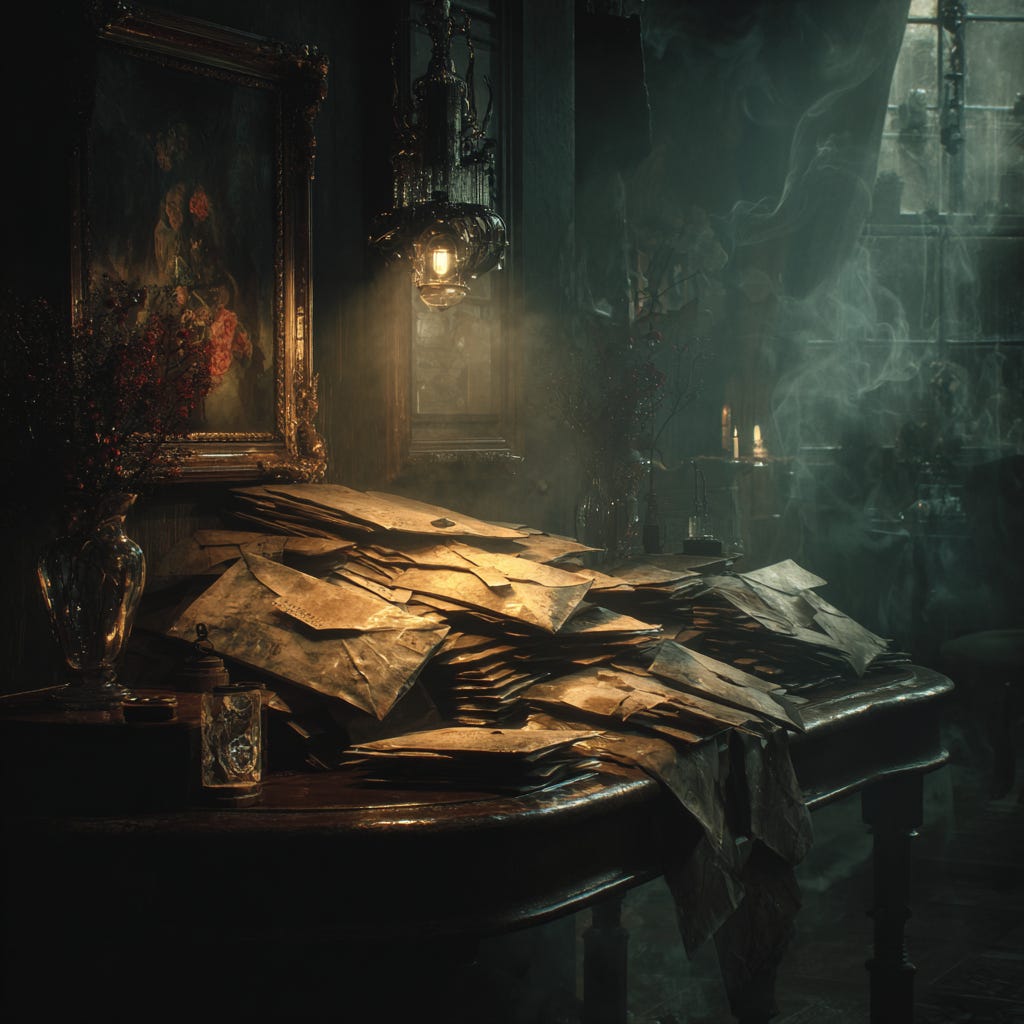
Letters accumulate on the hall table of my Father’s house — I will not receive them. Martha tells me he has also spoken with Cook and the housemaid about what I require by way of nourishment; he came yesterday morning before I was downstairs and spent a quarter of an hour in the kitchen explaining, apparently with great care and considerable charm, what foods would best support my recovery. Martha thinks him the most solicitous physician she has ever encountered. Cook has prepared what he recommended. I have not touched it.
This morning a separate package arrived from the letters — what appears to be one of his journals. A bound volume, his hand on the cover. I have set it on the escritoire and not opened it. I do not know whether he intends it as explanation or apology. Possibly he considers them the same thing.
I am not yet ready to determine what I intend to do with it.
I am not going to Sarah. She has baby Charles and I will not carry whatever I am into her house. I have sent word through Mrs. Hartwell that I am much improved and gone to Father’s for rest and quiet. Sarah will accept this — she has enough to occupy her, and I believe she assumed I would write to Thomas myself with news of my recovery rather than leave the telling to her.
I have not written to Thomas.
I will address that question another day, when I am more equal to it.
For now: Father’s house. Minimal servants. A door that locks from within. He will come — he has already sent word that he will call twice daily to monitor my recovery, because the first weeks are the most unstable. He will come, and I will not see him.
That much I can manage.
April 4th, 1862
He came this morning and again this evening. Martha tells me he inquires after my health at each visit with every appearance of genuine concern, and leaves whatever he has determined I may require in the hall — she says it with a warmth that tells me she has been charmed by him thoroughly, as everyone always is. Cook reports the same. He has been in that kitchen twice this week, apparently, suggesting preparations and speaking very knowledgeably about what would best restore my constitution.
My constitution. The word sits in my mouth differently now than it did three weeks ago.
I have not eaten what he sends. I have not read the letters. The journal remains on the escritoire where I placed it three weeks ago. I am not ready.
I am weaker than I was last week.
I understand the mechanism of this weakness, which is perhaps the cruelest feature of my present condition: I have no ignorance to retreat into.
I know what I need. I know what I refuse. I am aware that this position is not indefinitely tenable.
The hunger comes at all hours, without pattern. I have tried to discern a pattern because I understand things better when I can arrange them. There is none. It is not like ordinary appetite, which anticipates satisfaction and subsides in the meanwhile. It has no civility to it. No respect for the hour or the circumstance. It presents itself as a fact one cannot argue with, only endure — a wrongness, a deficit, insisting upon itself in a language that bypasses reason completely.
I endure it.
I have been wishing for some days to set down an account of what occurred last month. I have not been able to begin it. I have sat with this journal on three evenings and found myself unable to put the pen to the page in any satisfactory way.
This evening I feel I must try. There is no confessor I can go to — I would sooner burn these pages than speak of this aloud to any earthly minister, for the shame of it would be insupportable. But I require some record of what I have done. I require it for the same reason I require this journal at all, because silence around a thing does not diminish it, and I am the daughter of a physician who taught me that an unexamined condition is an unmanaged one.
On the twelfth day of March, I sinned.
I will not describe it. I tried — I opened my research journal, the one in which I have kept scientific observations since my time in the hospital, and I attempted to write it in the clinical register I have used for everything else, because that register has always helped me see clearly. I could not. I closed the journal and have not opened it since. The event does not admit of clinical description, or at least I am not yet the person who could write such a description and remain in possession of herself afterward.
What I will say is this: my reason had entirely abandoned me. A living soul suffered at my hands. That the suffering was brief — I will not make a comfort of that. The brevity was not mercy. It was appetite.
I do not believe I can be forgiven. I have searched the Scripture — and I know it well enough to know where the fault lines of grace run, where the promises hold and where they fall silent — and I cannot make the language of forgiveness cover what I have done. I am not despairing for the pleasure of it. I am being precise.
I expect I will continue to pray. It is the only discipline remaining to me that resembles the woman I was in March.
I have been thinking of Thomas.
He believes me dead. Or he has heard I recovered and wonders why I have not written. Both possibilities are awful in different ways.
I know what he is. A man of enduring faith and stalwart integrity — who wrote to me in letters of such careful restraint that everything they contained was visible between the lines to any reader who wished to find it — who told me, once, that he did not know how his soul should endure my removal from this earthly sphere. I know what he meant by that sentence. I know what he had been hoping for, what he was too principled to say plainly until there was occasion to say it plainly. And I know that whatever he had been hoping for required me to remain the person he had been corresponding with.
I am not that person.
I ought to write to him. A letter of release, carefully composed, that would allow him to close this chapter with the clarity he deserves. I have sat with paper and pen on several evenings now and found I cannot begin the sentence. This is vanity of the worst kind — clinging to a connection I have forfeited because releasing it means facing without any thread of my former life what I have become.
He would not want this. The Thomas I know — the Thomas who quoted Wesley at me across a parlor full of people who could not hear what he was actually saying — would not know how to want this. He came to this war as a minister. A man who walked toward suffering with the intention of ameliorating it.
What I am now does not suffer. What I am now causes suffering.
I cannot write to him.
Father is well in Baltimore. Sarah is gone south with young Charles. The letters accumulate on the hall table. He still comes twice a day to a door I will not open, and he is the only person in this world who knows what I am.
That he is both my deepest grievance and my only resource — the irony of it is too complete to contemplate with any equanimity.
I am very tired this evening. I am not certain whether I experience fatigue in any sense I would previously have recognised. But something in me is worn very thin.
If tomorrow differs from today, I will write more.
-
to be continued…
© 2025-26 E.M. di V. - writing as Morgan A. Drake & Joe Gillis. All rights reserved.