

Beautifully Dead - Chapter 45
An Immortal Affections serialized novel


Encampment on their way to Yorktown, Virginia
April 14th, 1862
The mail came to a besieging army the way mercy came to the undeserved: late, and never in the measure one had asked for.
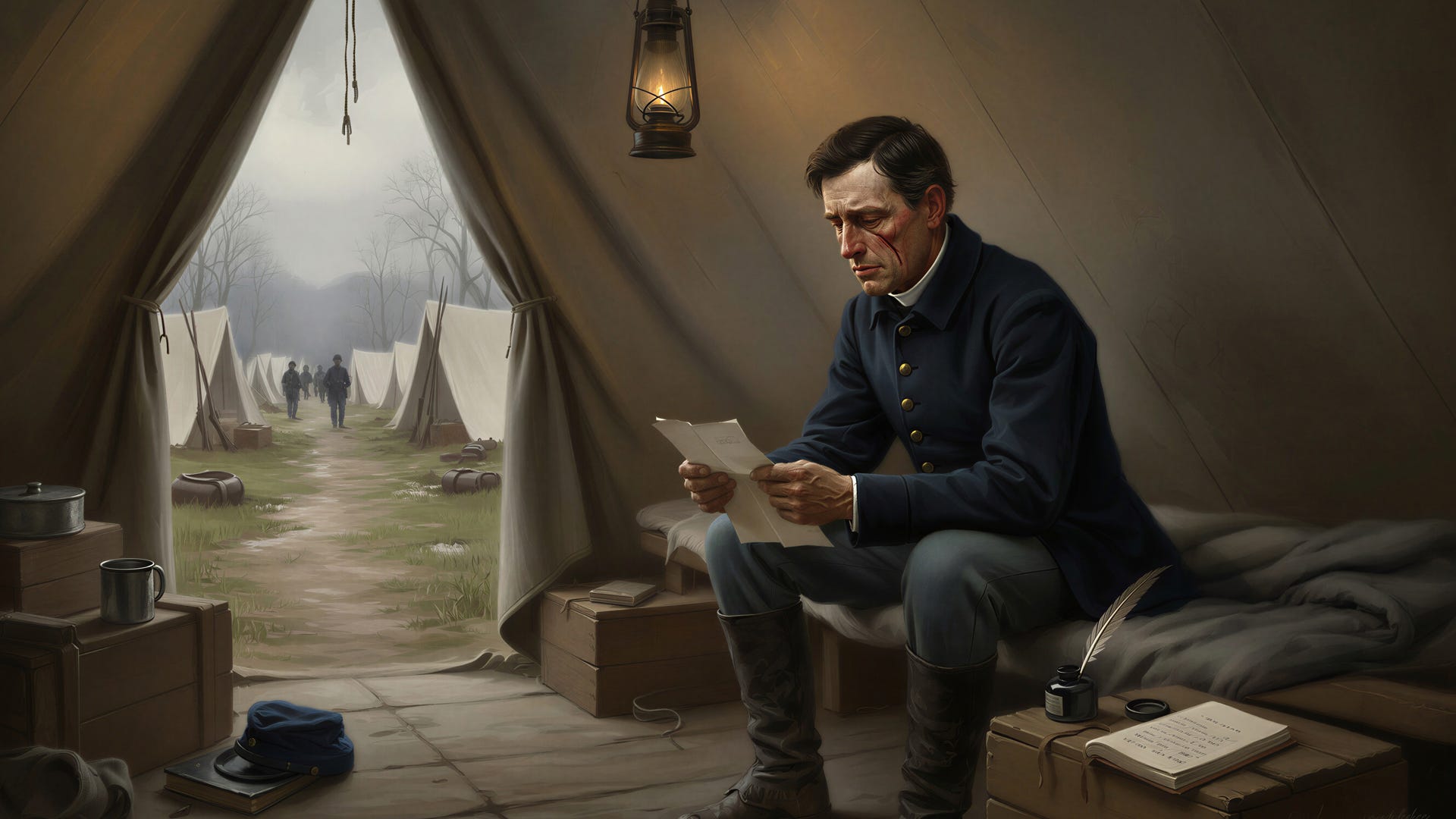
Thomas stood at the edge of the company street and watched the orderly work down the line, handing out the mail. He made himself stand still, even though every part of him wanted to rush over and see if news had finally arrived about Eleanor.
The day was remarkably calm for the men of the 22nd Massachusetts. Yorktown lay somewhere ahead. The company had done drills that day. Tomorrow they would be building bridges. Days before, the rebels attacked and tried to drive them back. Some of their men were wounded. More men were dying from the digging and the damp than any shot fired. Thomas had buried four since that skirmish, not one of them from that battle or any other. He knew the burial service without the book now. He could say the whole of it and think of other things while he said it—which was always about her—Eleanor.
His face ached in the cold. It always ached in the cold now. The scar pulled along his cheek to the jaw. Seasoned men had grown used to it. The new ones hadn’t, and he saw the flick of their eyes as they stole glances to the ruined side of his face, pretending they had not looked, even though there was no way they could not. He bore it. Vanity was a sin a Confederate shell had relieved him of, and he had tried for nine months to be grateful for the lesson, and still was not.
Today, like many other days, he was waiting for one letter. He had been waiting for it the better part of a month.
The last word had come from Sarah, and the last word had been bad. Eleanor was taken gravely ill. Weeks of nothing. Dread would over take him and tried to remove it with prayer. His prayers seemed to be unanswered then—
“Everett,” the orderly said as he held out a post.
Thomas took it and saw at once that the hand was not Sarah’s, and something low in his chest dropped.
It was a hand he knew. Reverend Halloway’s, the round, unhurried script of a man who had never in his life had cause to write quickly. Thomas did not break the seal where he stood. He carried it back to his tent and sat on the cot. And for a moment only held it. A sealed letter. While it stayed shut it might contain anything at all. He had come to dread the breaking of seals the way he had once dreaded nothing on this earth.
He broke it. He read it the first time the way a starving man eats, all at once, hunting the single thing he wanted—
My esteemed Brother in Christ,
I trust these few lines may yet find you. A gentleman of the Sanitary Commission, traveling north under flag of truce, has undertaken to carry what the ordinary post would never suffer to cross, and I have prayed over the writing of it as if prayer might mend the miles between us.
I write at Mrs. Everett’s behest. Your brother’s wife and her child are gone out of Richmond. The city has grown to be no fit place to raise an infant, and with your brother in the field and no settled protection near her, she has moved to be near her own people in the low country of Carolina, where she will be safe. She says you will know where exactly.
I will not presume to comfort you in your father’s passing with words of my own, for you have the Scriptures, and read them better than many I have ordained. I will say only this: he did not go unattended, nor unloved. The women of his house tended him to the last with a devotion I have seldom witnessed, and he died in the sure and certain hope.
For your brother I pray nightly, and for you—that the Lord keep you both, and restore you to one another when this scourge has run its course.
Yours in a fellowship no border may sunder,
Josiah Halloway
— and her name was not in it.
He read it again. Slowly this time, his finger moving under the lines the way he had been taught as a boy to read Scripture, that the eye might not outrun the sense. He read it a third time.
Eleanor’s name was no where to be found.
He sat with the page and tried to reason with why there was no mention of her. Halloway was a kind man. He would not withhold good news. If Eleanor lived—if she had risen out of that fever and lay mending—Halloway would have said so. It would have been the first thing he said. A man wrote first the thing that would do the most good, and there was no news in this world that would have done Thomas more good than her name with the word recovered set beside it.
The letter spoke of Sarah, and of Charles, and of his father, and of his brother. It had a tender word for each of them. For Eleanor, only silence.
The letter came without naming her. The women of his house tended him to the last. He read the line and his heart rose against all sense, for she had been one of those women. She had sat at his father’s bedside. Then he understood what the line was. It was an account of a deathbed. It spoke of the last moments. It told him she had been present when his father died and told him nothing of whether she herself drew breath. The single place the letter came near her was a grave.
He laid the page down on the blanket very carefully, as though it might break.
Thomas had become accustomed to death. He watched men die nearly every day since he joined. And in so many ways. The worse of which came from the fever wards. Whatever took them was of the devil—their eyes emptied out, the man departed the body and left the body walking the Earth, snapping its teeth, a hunger for their fellow man. He had prayed over those men and his prayers had availed nothing, and he had concluded that what afflicted them was older and worse than any fever, and went by a name he was not permitted to use.
Every fiber in his being hoped that was not what had captured his beloved Eleanor.
If Eleanor had passed, he prayed that she had been spared the thing he had failed to drive out of Private Roberts.
In March he had written to her of the Revelation of John. He had copied the verse out in his own hand—that God should wipe away all tears from their eyes, and there should be no more death, neither sorrow, nor crying, nor any more pain, for the former things were passed away. He had believed it when he wrote it. He had needed her to believe it with him. He tried to lay hold of it now and found it would not bear his weight. There was only one death he would want undone. One single death, one possible grave—and the God of the Revelation did not traffic in that.
He should commit it to paper.
He kept a record. A man who kept no account of his griefs did not master them—some version of that his father had taught him, in the years when his father still taught him things. He drew the journal from beneath the cot and uncapped the ink and sat with the pen poised above the page.
The date he could manage. He set down the date.
Nothing came after that. There were no words that did not lie. To write her dead was to make it a fact by his own hand. He could not do it. To write otherwise was to hope, and he wasn’t sure he had that anymore. He tried to bury the hope beside the rest of her. But he couldn’t.
He sat in doubt so long, the ink dried on the nib.
After a time he capped the bottle and returned the journal to its place beneath the cot, the page bearing only the date and a great silence underneath it.
-
to be continued…
© 2025-26 E.M. di V. - writing as Morgan A. Drake & Joe Gillis. All rights reserved.