

Beautifully Dead - Chapter 35
An Immortal Affections serialized novel


From the Private Research Notes of Dr. James Merriweather
March 9th to 12th, 1862
[A number of pages heavily damaged—ink blotted, paper crumpled and torn, precede the following notes]
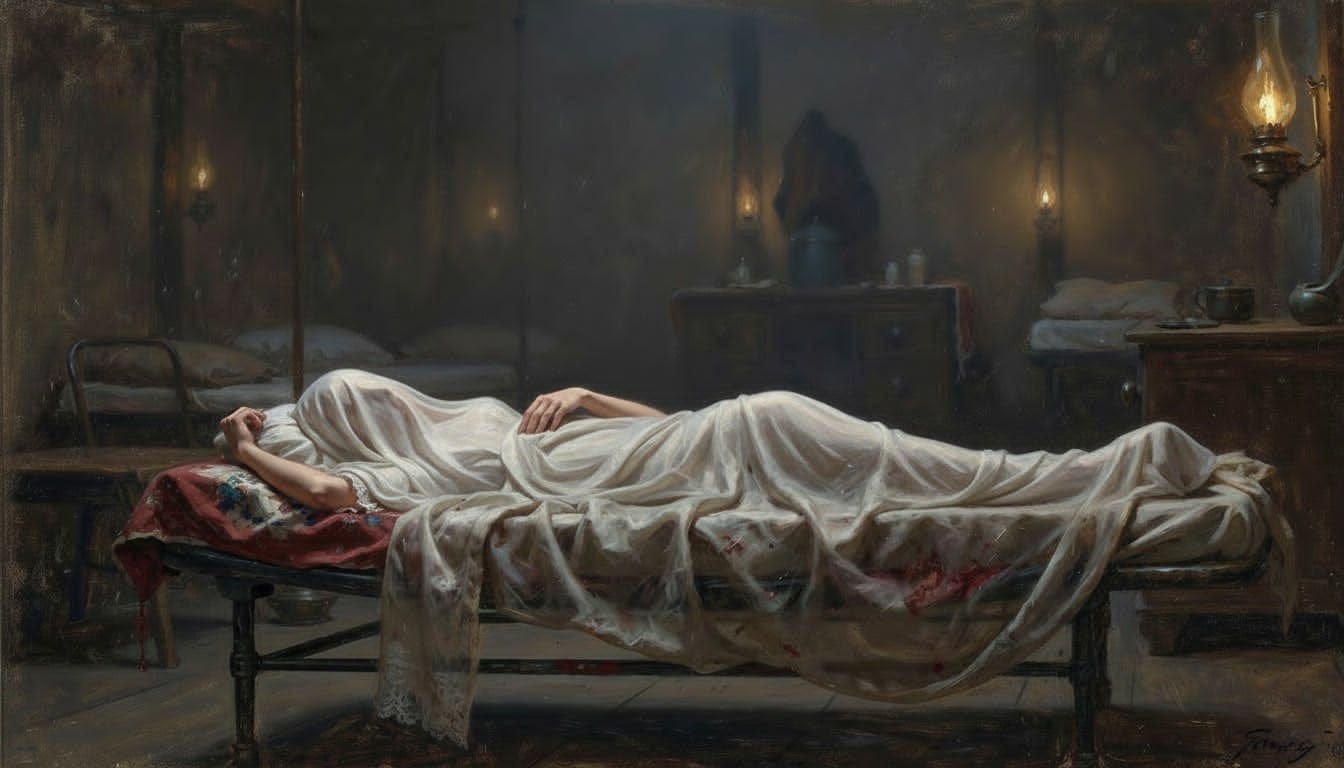
Eleanor Caldwell died at 5:43 on the afternoon of March 11th.
-
The Matthews incident occurred on the evening of March 9th. She was alone with him when he broke the four-man restraints, subjecting her to a violent assault. A sudden and overwhelming exposure to the affliction ravaging him, rather than the controlled progression I had calculated. Within eight hours her fever had spiked, and again by morning.
The pattern was immediately clear.
I have documented this cascade in every failed subject—once the crisis begins, systemic collapse proceeds along the same terrible trajectory.
Her progression lasted three days, longer than I would have imagined, but hopelessly fatal. I will reconstruct the clinical sequence as precisely as memory allows.
During that first night, the temperature climbed to 105, reaching 106 by dawn. Violent emesis began—bile at first, then blood as the gastric lining deteriorated. Profuse diaphoresis persisted despite increasing pallor, the body attempting simultaneously to burn out the morb and conserve what vitality remained.
Futile efforts.
By evening the tremors had escalated to full convulsions. Petechiae spread from the bite site in that distinctive radiating pattern to her whole torso.
By the time night fell again, hemorrhagic manifestations had begun. Epistaxis first, then gingival bleeding. The blood ran dark and would not coagulate properly. The nurses worked in rotating shifts—none could tolerate more than an hour in that room. They handled her with the particular caution one reserves for the manifestly dying. The smell alone would have confirmed their assessment: corrupting flesh beneath fevered skin.
Through the following day, consciousness was lost entirely. Her respiratory rate averaging perhaps twenty breaths per minute, but shallow—insufficient to sustain life much longer. The cardiac rhythm grew irregular, pulse thready and weak.
By late afternoon of March 11th, her heart simply ceased. Respiration moments after. She showed no response to any stimulation following.1
The staff believes I maintained constant vigil throughout her decline. They observed my presence at irregular intervals and constructed their narrative accordingly. In truth, I came and went as circumstances demanded. They saw what they expected: a dedicated physician, a family friend, attending a promising young volunteer in her final hours.
I was simply too angry to maintain the usual pretense. The carefully constructed comportment of the concerned doctor, the measured responses, the appropriate expressions of professional regret—I had no capacity for any of it.
Better to let them interpret my absence of affect as stoic dedication than to risk revealing what actually burned beneath.
Their assumptions have served me well enough. My reputation within the hospital has, if anything, been enhanced by this incident. The staff speaks of my tireless efforts, my refusal to abandon a difficult case, my commitment to documenting even terminal progression for the advancement of medical knowledge.
I could barely contain my fury.
Three years of cultivation, destroyed in three days.
I arranged Eleanor’s proximity to the Everett patriarch in early 1859. That placement alone required months of careful work—building the father’s trust, nurturing her interest in the family, establishing the medical pretext, ensuring she would be the natural choice when nursing care became necessary. Nearly three years of sustained low-level exposure, during which I monitored her adaptation with meticulous attention while she remained entirely ignorant of her significance.
My controlled progression theory demanded this extended timeline. Every other attempt in the past decades had employed acute and overwhelming exposure—the contagion delivered to naive subjects. They all died, some in days, others in hours, but the mortality rate remained universal regardless.
Eleanor was meant to prove the alternative approach. Prolonged exposure would prime the constitution for controlled adaptation rather than overwhelming it with sudden assault. The recent laboratory test confirmed the approach was sound—her blood showed alterations exceeding anything I had previously documented, yet her mental faculties remained not just intact but enhanced.
I had calculated eighteen additional months of carefully managed contact in the fever ward. Progressive exposure to increasingly severe cases, building systematically on the foundation established through the Everett patriarch. The endpoint—whether controlled transformation or complete resistance to the affliction—would have definitively proved my theory
Lt. Matthews destroyed it all in a single moment of uncontrolled violence.
The error compounds itself. This is not merely the loss of one particular subject, but the waste of the arrangement that made her possible. Three years cannot be quickly recovered. The convergence of factors that made Miss Caldwell the perfect subject required years to construct and may not arise again within any useful timeframe.
I will have to conduct another iron test on the remaining female volunteers within the week. Nothing that will raise questions. If any show the blood alterations that indicate early adaptation, I can begin the cultivation process again.
I have little hope of finding another suitable candidate. And this war may not last that long. My access to concentrated afflicted populations depends entirely on the continuation of hostilities and the medical chaos they generate.
If peace comes, if normal civil order reasserts itself, if the fever cases diminish or disperse—the framework I have built here collapses. Richmond has provided ideal conditions these past years, but I know very well these conditions will persist indefinitely.
I must consider whether to remain here hoping for another suitable subject, or to move to a different city where epidemic conditions might offer fresh opportunities. Philadelphia, perhaps. Or back to New Orleans if the yellow fever season proves severe.
There was one element of Eleanor’s case that differed from all previous subjects.
During the final delirium, she described visions with unusual specificity. Most subjects in terminal fever exhibit standard hallucinations—fragmentary, disorganized, containing nothing that extends beyond their own limited experience. Her visions were of a different quality entirely.
She spoke of cities burning with elaborate detail. Atlanta consumed in flame. Charleston reduced to ashes. Richmond besieged. All described as though she witnessed them directly, yet these are events that have not occurred and may never occur.
Then the visions shifted to landscapes foreign to her. Stone cottages with thatched roofs. Mist-covered hills. Rain falling on heather. The smell of peat fires. The sound of distant pipes.
She spoke for hours, until her voice broke. Not of Virginia, but of places I recognized from long ago.
And a name I would not expect to hear on the lips of the living.
Cat.
Decades, and no other subject has displayed this specific phenomenon. Terminal delirium typically contains only fragments drawn from the subject’s own experience, their own memories distorted by fever.
Eleanor Caldwell saw something else.
The orderlies leave my office this very moment, after reporting finding Matthews corpse during the morning rounds. Dead in his restraints during the night, or in the early morning.
One does not hesitate with a mad dog.
I have sent for the undertaker. He will need to make arrangements for both of them. And I should send the nurses to wash Miss Caldwell’s body and prepare it for the family’s viewing.
The room will need airing out.
to be continued…
© 2025-26 E.M.V. - writing as Morgan A. Drake & Joe Gillis. All rights reserved.GLOSSARY OF MEDICAL TERMS
For readers unfamiliar with 1862 medical terminology and clinical descriptions
MEDICAL TERMINOLOGY
Emesis - Vomiting. The act of expelling stomach contents.
Diaphoresis - Profuse sweating. Excessive perspiration beyond normal body temperature regulation.
Epistaxis - Nosebleed. Bleeding from the nasal passages.
Gingival bleeding - Bleeding from the gums.
Petechiae - Small red or purple spots on the skin caused by broken blood vessels. Appears as tiny hemorrhages beneath the skin surface.
Coagulate - To clot or thicken. Blood’s natural process of solidifying to stop bleeding.
Gastric lining - The interior lining of the stomach.
Pallor - Abnormal paleness of the skin, often indicating illness or blood loss.
Convulsions - Violent, involuntary muscle contractions. Similar to seizures.
Thready pulse - A pulse that is weak, rapid, and difficult to detect. Indicates poor blood circulation.
Cardiac rhythm - The pattern of heartbeats.
Respiratory rate - The number of breaths per minute.
DISEASE TERMINOLOGY (as per historical context)
Morbific matter - In 1862 medical theory, disease-causing substances believed to corrupt the body. James uses this term for what we would now call infectious agents or pathogens.
Miasma/Miasmatic influences - The prevailing 1862 theory that diseases spread through “bad air” or poisonous vapors. Germ theory was not yet widely accepted.
Systemic dispersion - Spread throughout the entire body system, not just localized to one area.
Localized concentration - Disease material concentrated in one specific area before spreading.
Terminal stage/episode - The final phase of an illness, typically ending in death.
Acute exposure - Sudden, intense contact with disease material all at once.
Naive subjects - Medical subjects who have had no previous exposure to a disease, thus no developed resistance.
Primed constitution - A body that has been prepared through gradual exposure to develop resistance or adaptation.
CLINICAL OBSERVATIONS
Hemorrhagic manifestations - Signs of internal or external bleeding.
Constitutional decline - Overall deterioration of the body’s health and vitality.
Higher faculties/reasoning - Mental capabilities including logic, memory, self-awareness, and rational thought.
CONTEXTUAL NOTES
Undertaker arrangements - In 1862, bodies were typically handled quickly, especially fever deaths. Minimal preparation, prompt burial, and no autopsy were standard for infectious disease deaths.
Medical credentials and reputation - In the 1860s, physicians built practices through reputation and word-of-mouth. Hospital positions required careful cultivation of professional standing within medical communities.